

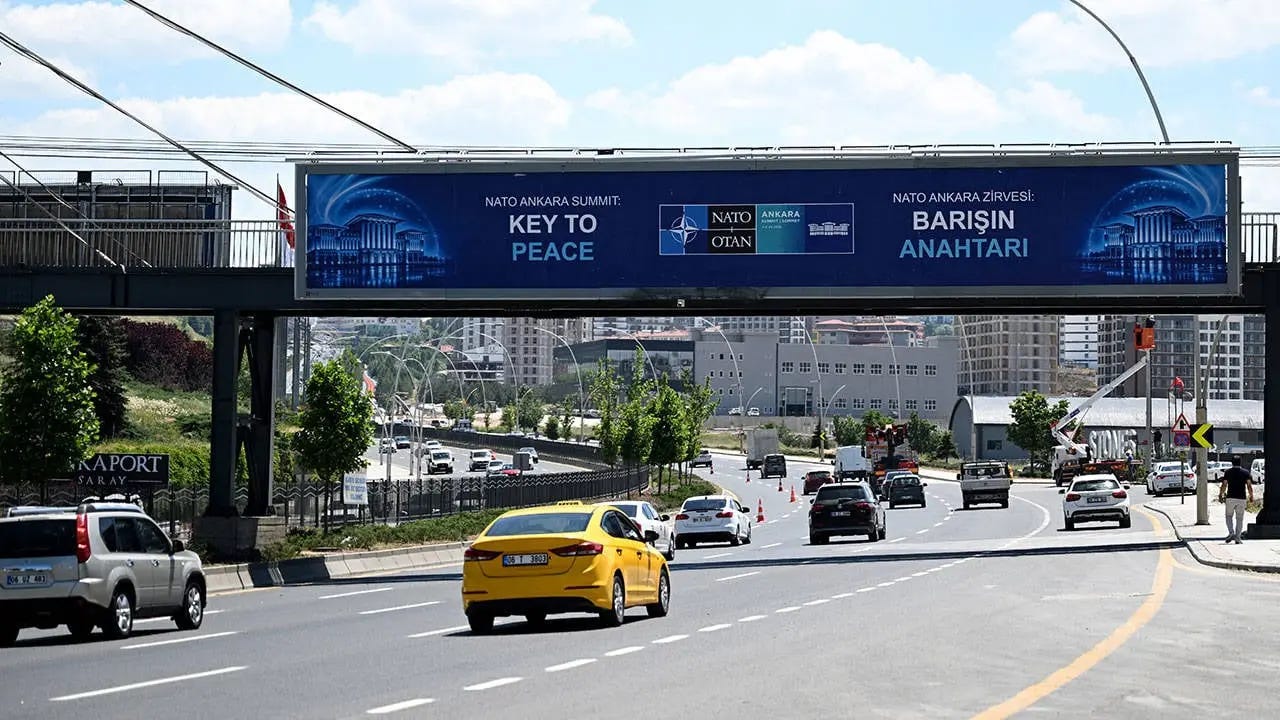
NATO leaders are gathered in Ankara today for this year’s summit. It being set in my home town, I’m following the summit with unusual detail this year, and it fills me with dread.
But before I get into that stuff, I’d like to enumerate some things that are good, or at least not terrible, because things could have been a lot worse, both for NATO as a whole, as well as for Turkey.
First, Trump has actually created a new urgency among the Europeans to get serious about defense. And they have. They have made significant budgetary commitments and are making much bigger commitments to the defense of Ukraine. Speed and depth continue to be serious issues, but at least they’re moving, and I’m not sure that it would have happened without Trump, so there is that.
Second, Turkey is an ally in good standing. I was more pessimistic about this. There was a stretch there in the late 2010s, when it was pretty uncertain where things would go. The coup attempt rattled Erdoğan, he bought the S-400 air defense system from Putin, calling it “the most important agreement in our modern history.” The economic rollercoasters, military adventures in Syria, excursions to the Kremlin, all meant that Turkey was kind of dangling off the edge there for a while.
Had a real rupture occurred, Turkey would have been much worse off. Israel now says things like “Turkey is next,” and it doesn’t alarm us too much in Turkey. We had been on our own, that kind of a threat would have been a lot more serious. There would also have been untold effects on the fundamentals of Turkey’s economy and politics.
Here are also my comments on the NATO summit for The New Yorker, The New Statesman, The Times, and Middle East Eye.
So what changed? We don’t have the journalists to look into it and tell us what exactly happened, but I think that the presidential palace came to the understanding that they simply didn’t have the ability to distance themselves from NATO. They don’t have the technology and the capital to make it work, and they had to have that little adventure to come to terms with that. It is said that in 2022, well before Trump re-entered the Oval, Erdoğan’s Atlanticist team was already working hard to mend fences in Washington. Trump’s arrival made everything easier, and assured a smoother landing for Erdoğan.
Turkey is hailed as a “big winner” of this summit, but that’s lazy thinking. Many of the things that Erdoğan’s people are now hoping to get from Trump are things that Turkey lost during its Eurasianist turn of the last decade: trust, a working industrial relationship, and access to top-shelf weapons like the F-35. It’s still not clear how much of that will be restored. Turkey will get some business supplying the lower end of Europe’s defense needs, grow, and use that business to develop its own ecosystem of indigenous weapons (the Baykar drones, the MILGEM corvette, KAAN fighter plane, etc.)
We’re now getting into the reasons for my dread, and there are many.
The Military Keynesianism that Europe is embarking upon doesn’t sound like it’s going to be pleasant, making everyone more precarious, detaching politics from policy, and especially fueling far-right movements. In Turkey, we’re already at a far more advanced stage, and as the defense industry grows to produce the ammunition the rest of the alliance needs, the country is going to eat itself even faster.
It is also grotesque how personalized and undemocratic all of this has become. Though they are undeniably skilled politicians, leaders like Trump and Erdoğan lack any sense of honor and intelligence that leadership on this scale requires. NATO might not even exist any more if it hadn’t been for Mark Rutte’s willingness to debase himself entirely to woo Trump. Turkey is once again an ally in decent standing, but the process has occurred light years away from any kind of public accountability. The way that Erdoğan’s regime moved heaven and earth to scrub Ankara clean ahead of the NATO summit shows how much contempt they feel for the people of their own capital.
The progressive hope for NATO would have been to curb its anti-democratic aspects, and to build it into something deeply rooted in the societies it protects. The opposite is happening. As a consequence, our children are growing up in a world that is far less secure than the one we grew up in. The only hope left is for a political reversal in the United States, as well as for the cordon sanitaire in Europe to hold.