

This is a weekly post wherein I write about things I’ve been reading, watching, and thinking about. The first part is free, the rest is for paid subscribers only.
Hi folks,
My kid has started nursery today, and I’m finally back to work. Expect two posts a week from here on out.
In this edition of Notebook, I thought I’d go through a bunch of things I took notes on during the summer, but never got around to writing up.
Kemal Büyükyüksel on the cruelty of hope
I’ve written about Büyükyüksel before. He writes some very good essays on the state of Turkish opposition politics. This one is on the mentality the opposition needs to adopt (or rather, the one it should avoid) to make it through the Erdoğan period.
The problem, as with Büyükyüksel’s other essays, is that he could really benefit from an editor who’d tighten his prose significantly.
Either way, here are some parts that stood out. Translations by AI:
First one has to describe the situation somewhat mercilessly. There is today in Turkey no known, workable and reasonably reliable path by which the opposition might change the government. It is not pleasant to say this. One immediately wants to add a reassuring sentence after it.
He argues that the Erdoğan regime has pretty tight control of the country’s institutions, and that it has no intention of leaving, meaning that it won’t hold fair elections, and even if it somehow lost in an election, probably wouldn’t leave.
So how is this going to change?
We don’t know.
It’s that simple and that uncomfortable.
Maybe an election will set something off. Maybe a crack will open up inside the government that isn’t visible today. Maybe the question of succession after Erdoğan will shake the whole system. Maybe some economic or international development will change the actors’ calculations. Maybe the process on the Kurdish question will produce an unexpected political outcome. Maybe some form of organisation that cannot be imagined today will emerge from within society or the opposition. Maybe several of these will happen at once. It is also possible that nothing happens for a long time.
Listing these is not especially meaningful in itself. Something else matters more. Some of the variables that will prove decisive in the future may not even be part of today’s political calculus. So the problem may not just be that we don’t know the answer. The answer may not have formed yet.
He goes on to cycle through some academic theories about hope, and how treacherous it can be in such political settings, but I think it’s really this bit that got him going on this essay:
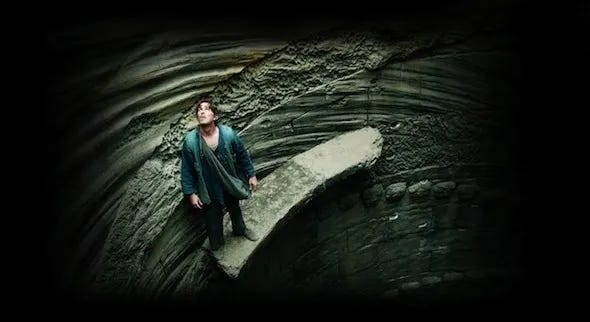
In the final film of Christopher Nolan’s Batman trilogy, The Dark Knight Rises, the main antagonist Bane, having broken the back of Bruce Wayne — that is, of Batman — throws him into a prison in a forgotten corner of the world, a pit sunk into the earth. Before abandoning him there, standing over him, Bane spells out his own philosophy of hope: “There can be no true despair without hope.” He then states even more plainly his plans for the city of Gotham, which he holds hostage: “I will feed its people hope to poison their souls.” He will give people hope that they can be saved, and poison their souls with precisely that hope. For Bane, the cruelty of hope lies in the fact that it does not deprive a person entirely of the possibility of deliverance.
The prison Wayne is confined in is designed accordingly. It is a pit in the ground, but it is not wholly sealed. The sky above is visible. The possibility of escape is right there before your eyes. The torture of the prison is not so much being buried in darkness as seeing the light constantly and never reaching it. Bane does not abolish hope. He makes it part of the punishment, part of the suffering.
I would not, of course, want to reduce Turkey’s situation to a Batman film. Still, there is something uncomfortably familiar about that scene, and about a prison shaped like a pit. Public debate in Turkey about the fate of the regime, or about the opposition, has long been unable to take its eyes off the mouth of the pit. The next election, the strong candidate, the latest poll, the chance of İmamoğlu’s release, the moment the economy finally squeezes the government, the rupture expected from within, the post-Erdoğan era. A significant part of the media keeps the conversation revolving around these same possibilities. Candidates, polls, backroom gossip, election scenarios and the small political excitements manufactured afresh each day keep an endless show running. Whatever share of this is deliberate, political attention is held continuously within the same narrow space. Opposition-minded society, too, is confined to living its politics as a matter of watching which of these possibilities will come to pass. It clings to the crumbs of hope thrown in front of it.
People do not like a void. Neither does politics. And so for years we have held on to different versions of the same sentences. The wheel will turn [devran dönecek]. The people will give their answer at the ballot box. They can’t go this far. The economy won’t hold out in the end. At some point the state will say enough. It will all backfire. Erdoğan will make a big mistake. If the opposition gains a few more points, the balance will shift. Any one of these might genuinely turn out, one day, to be part of the way out. The problem is not that the light is false. The problem is that an entire political life can be spent looking at it. What all these crumbs of hope have in common is that they make today’s uncertainty bearable through the thought that a way out will somehow be found in the future. But once a possibility stops being merely a possibility and turns into a prop that lets us defer confronting our present condition, hope begins to work differently.
I should note that Behlül Özkan and Evren Balka have also written about “Cruel Optimism” (Zalim İyimserlik) with reference to Lauren Berlant.
It’s fine of course, for intellectuals to write these things, but we’d be naive to think that this sort of thing actually has much of an impact on the way politics is conducted. The question really is: does the political elite of the opposition understand that they need to touch base with reality, adjust expectations, and gradually direct the emotional charge of their base?
Welcome to Barrackiye
Ata Armağan and I have been texting back and forth about this weird subculture on the internet where users combine the symbols of US ambassador Tom Barrack, cheap fast food, and the khalifa.
In this bizzarro narrative, Turkey is a country called “Sünniye” or “Barrackiye,” and is governed by Tom Barrack. As the name suggests, this is a country that acts as a forward garrison of the United States, and specifically as a pan-Sunni counterweight to the Iranian “Shia Crescent”. Its children either die in the trenches of Middle Eastern wars, or they eat awful fast food that makes them fat, compliant online trolls that defend the narratives of Sünniye.
The narrative was around for some time, but recent developments like the Turkey-Pakistan-Saudi defense pact, the partial amnesty to the PKK, the degradation in the rule of law, the presence of ever-growing numbers of migrants in Turkey, and most important of all, the deteriorating economic situation for the vast majority of the country’s people, have all acted as rocket fuel for it.
The vast majority of “Barrackiye” content is really awful AI-generated visuals and videos. Here’s what it looks like:


Part of this is a secular alt-right movement that’s attacking the Erdoğan regime from a position that alt-right figures in the West have been attacking progressives.
