

As Turkey’s national team was preparing against its first match against Australia, Erdoğan released a catchy music video.
It was set to the tune of a classic, highly energetic folk song. The refrain had been changed to “siz hepiniz, biz Türkiye!” [you all together, us as Turkey], a schoolyard challenge: “you all against me!” Because the Turkish team was brimming with so much energy that it would take on the whole world.
The video collage also featured attack helicopters, fighter planes, tanks, indigenous electric vehicles, all told the story of a country that was ascending to the next geopolitical level.
And Erdoğan no longer pretended that he wasn’t going to politicize the national team. There were several hero shots of him sprinkled in, and the whole thing ended with the logo of the AK Party. And there it was: the holy trinity of the New Turkey: the army, the eleven, and the reis, fused into a three-minute hymn.
You could no longer root for the national team and not support Erdoğan’s political project. As far as I’m concerned, this was a big middle finger to the majority of Turkey’s citizens who support the opposition.
That was eleven days ago.
After two humiliating defeats, our valiant team has been eliminated, and is en route to the motherland. [edit: I didn’t realize we had to finish the group, and play against the USA. Brutal.]
You may think that your humble blogger is off his rocker, but I think this is an event of real political significance. When the historians write of the “late Erdoğan period,” they may well cite our obliteration in the 2026 World Cup as a milestone in the demise of this regime.
Sure, nationalists are always adamant about sports, but I submit to you, dear reader, that some kinds of nationalists care more about it than others. Some kinds of nationalists don’t just want success in sports, they need it.
Turkish Islamism of the kind Erdoğan embodies is a form of revivalist nationalism, or what Roger Griffin has called “palingenetic ultranationalism.” In Turkish Islamism, this is the doctrine of “Diriliş,” as put forward by Sezai Karakoç, literally meaning “resurrection.” The idea is that you first restore the nation’s authentic identity, and then watch as its civilizational strength manifests. This is why Erdoğan cares so much about restoring Hagia Sophia into a mosque, or educating a “pious generation.” Once that’s done, the belief goes, the nation’s creativity, passion, and vital energies will be unleashed. Families will prosper, the economy will boom, the military will dominate, and Turkish technology firms will be at the cutting edge. You won’t even have to think too hard about policies and the like. (That’s for pesky libtards.)
If the great leader holds on to power long enough, however, he finds that people don’t see things the way he does. They might focus on inflation rather than economic growth. They might speak of traffic jams, rather than the roads you’re building. They might question the military bases you’re building in other countries, and ask for trade deals. For some reason, people are relentlessly negative and claim that the “century of Turkey” isn’t materializing at all. Some even have the temerity to claim that the country is worse off than before.
But the one thing that’s undeniable is athletic success. That’s where you show everybody that you have elevated the country to the big leagues. The scoreboard does not lie. International gold is indisputable.
That’s why Erdoğan cares so deeply about athletic performance. It’s why he went into the World Cup this hard. To his credit, he is a risk taker, a believer, and he was willing to bet that the national team could hand him excitement, and ultimately victory. He probably wanted them to play against the big European teams, and even if they didn’t win, they’d make people feel that the country was now a force to be reckoned with.
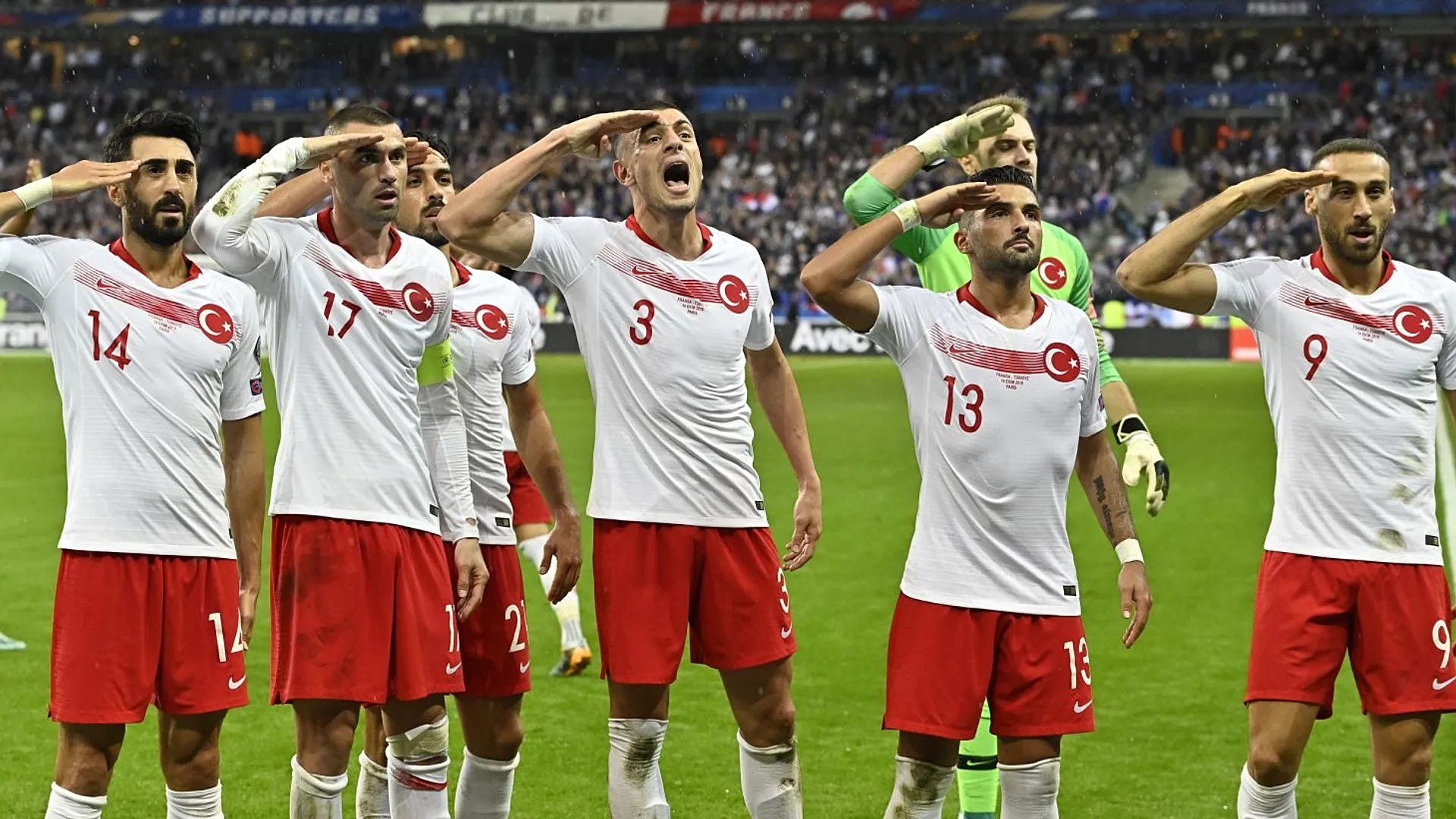
If that had happened, the trinity of military-sports-president would have been complete, and brought him much-needed political relief.
It didn’t happen though. And I think it’s part of a wider story of athletic underperformance, and ultimately, a story of the wider institutional failure of the Erdoğan regime.
But let’s briefly look at Turkey’s athletic performance first. Consider the country’s Olympics medal count since 1964:
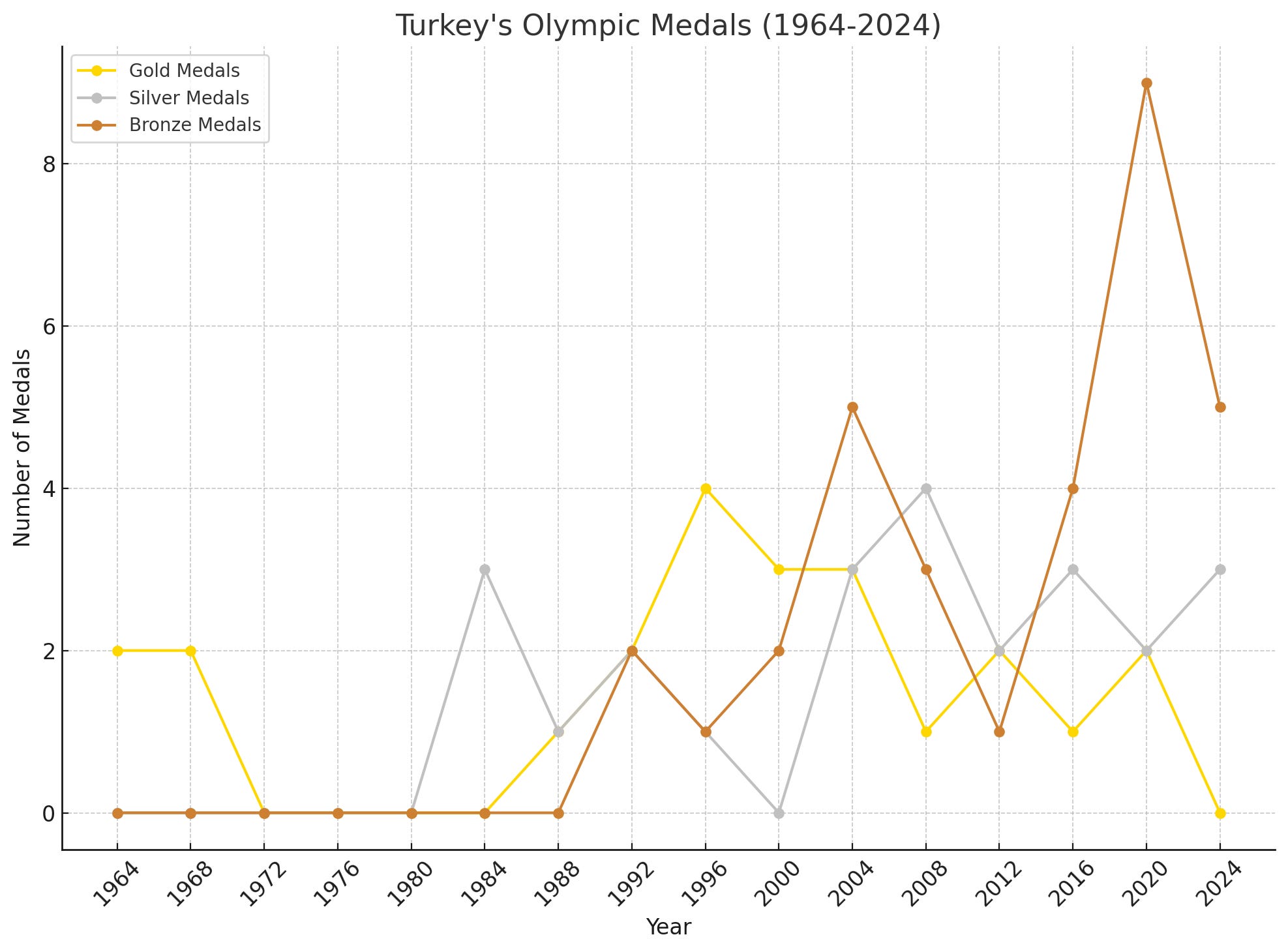
Keep in mind that bronze and silver are nice to have, but countries are commonly ranked by the number of gold medals they earn. By this measure, there’s an upward tick in the 90s and early 00s, but the count is insignificant and ultimately collapses to zero in 2024. After almost a quarter century of AK Party rule, Turkey finishes 64th in the Olympics.
No “national revival” here.
It’s the same in national soccer. Like most Turkish millennials, I have vivid memories of watching our team in the 2002 World Cup. All of my friends and family were glued to the TV. It was electrifying. Our team played some amazing games, and came in third. Our team acquired a reputation for uneven genius that it still carries to this day.
I was young, but I don’t remember anything political about it.
Then we went 24 years without qualifying for another World Cup, only just making it this year, as FIFA expanded the tournament from 32 to 48 teams.
And we lose. Badly.
I suspect that Turkey’s national athletes lose especially badly the closer they are to the Erdoğan palace. The olympic wrestling and lifting teams, as well as the national soccer team, are straight up Erdoğanists, so they are already hopelessly politicized. As with any institution that gets into the Palace’s orbit, they are flooded with cronies and adventurists, and whatever potential they have dissipates into thin air.
But look at other sports, and the poisonous influence of far-right politics is even more evident. The young archer, Mete Gazoz, won gold at the Tokyo Olympics. He won the individual recurve title at the 2023 World Championships in Berlin, the first Turkish archer to do so, and then in May 2024 — about three months before the Paris Olympics — he won the European Championship in Essen.
This kid is a genuine talent, and going into the olympics, he was on TV all the time, either on commercials, visiting schools, or shaking hands with the Erdoğan family. I bet that all manner of palace creatures started calling his family and showered them with attention. This being archery, the “ancestral sport of the Turks,” the regime built him up into their civilizational superhero.
And lo and behold, he got bronze at the Paris Olympics.
And to be clear, I don’t think it’s the fault of the individual athletes. They’re shaped by the environment they’re in. I don’t think that Mete Gazoz should or could fight off the regime’s attention. They need him too much.
Still, the touch of the Erdoğan regime is the surest path to mediocrity, or worse.
The only sporting event where Turkey is doing well is women’s volleyball, where our team is arguably in the top-three in the world, and surprise! they’re fairly distant to palace circles. Their cultural vibes are distinctly secularist, and the bulk of their support comes from opposition voters.
Now I don’t want to say that this proves that revivalist or authoritarian nationalists are inherently losers, and that democracy is consistently better at producing results. That could require much more rigorous research.1
I do think, however, that it says something about the abilities of the Erdoğan regime at large. They are not good at producing results, even when they really care about it. And it’s becoming more and more obvious. A strong performance at the World Cup would have been a boon for Erdoğan, but a loss is worse, because it confirms the fears that people have about his regime.
Ten years ago, their palingenetic claims were much more evident. Their boosters claimed that they managed the economy well, that society was thriving, that families were happy, and that the country was booming. They no longer do. They’re down to security and geopolitics as the remaining areas of competence, but even that is highly dubious.
China, for example, thinks of itself as coming out of a “century of humiliation,” and has consistently done well in international sports competitions. They’re not a soccer country, but they were tied with the United States with 40 gold medals in Paris (the Americans had much more bronze and silver, but still, hugely impressive.)
Great post as usual! I'm surprised by how much you manage to draw out of this event. I'm curious was sports in Turkey not politicised in Turkey in the 2000s and is the Turkish government investing in sports? To make a comparison to China, my impression is that China invests a lot in talent and is competing to do well in many sports and on many levels. It also seems more aware of its shortcomings and strengths.