

Hi folks,
Today I have the pleasure of publishing the below essay by my dear friend and former colleague Omar Kadkoy.
He’s writing about how Syria is renaming schools, and what that tells us about the political transformation the country is going through. I wasn’t surprised by the new policy, as much as how quickly it has been rolled out. It appears that it has already met resistance, and sometimes successfully.
As mentioned in previous posts, I’ve been traveling and spending time with family, so posting has been very light. The late-summer lull is by now a regular occurrence at Kültürkampf, and it helps me tackle the new working year with vigor.
I’ve rented some new office space and am itching to get back to work. I’ll have another post out in a few days, and will ramp things up starting next week.
All the best,
Selim
I was scrolling through Facebook a while ago – very Millennial, I know – when I came across a post by the Circassian Benevolent Association in Damascus. The Facebook post concerned a proposal by Raqqa’s Directorate General of Education to remove the names of 20 schools in the governorate and replace them with supposedly “more suitable” ones.
One name immediately caught my attention: Jawad Anzor, a Syrian of Circassian descent. Avid readers of Kültürkampf might remember that I come from the same background, so this sparked my interest. But the list extended far beyond this Circassian figure. It included several heavyweight names familiar to generations of Syrian schoolchildren, among them Sati‘ al-Husri, widely described as the “philosopher of Arab nationalism” because of his extensive writings on the subject in the early twentieth century. It also included a school named after Evacuation Day, Syria’s national day, which commemorates the departure of the last French troops from Syria on 17 April 1946.
This raises a question: what was this conflict about? While the outside world calls it the Syrian Civil War, we have long insisted on calling the conflict “the revolution.” But what was that revolution? Is Syria removing the symbols of dictatorship, or replacing one official national identity with another?
The proposal of Raqqa’s Directorate General of Education draws on the Ministry of Education Circular No. 1470/534, issued on 25 September 2025. The circular presents school renaming as part of an effort to “strengthen national identity,” “overcome the effects of the previous era,” and “remove names associated with symbols of the former regime.”
The circular also establishes the criteria and procedure for renaming schools. Under the criteria, schools may be named after the area where they are located; figures or symbols of religious, cultural, or historical significance to Syrian society; influential scientific, national, or cultural personalities; or inspiring concepts, such as wisdom and freedom that reinforce students’ national and humanistic belonging. Procedurally, the local directorate general of education proposes the new names and submits them to the governor for approval. Once approved, the directorate formally changes the names in question.
No official statistics exist on how many schools and cities have undergone or will undergo the change. Unofficial sources suggest that the number is 128 schools in Aleppo, 28 in Damascus and over 500 in Hama.
Breaking with the legacy of the former regime is necessary, and I am all for it. Treating every name inherited from Syria’s past as an extension of the fallen regime, however, is neither based in reality nor desirable.
From what I can tell about the policy’s implementation, renaming Syrian schools encompasses two essentially different endeavors that can easily be confused. The first is a legitimate process of de-Baathification and de-Assadification that can contribute, at least symbolically, to transitional justice. The second is a far more controversial attempt to determine which political, religious, and cultural traditions will be allowed to embody the “new Syria.”
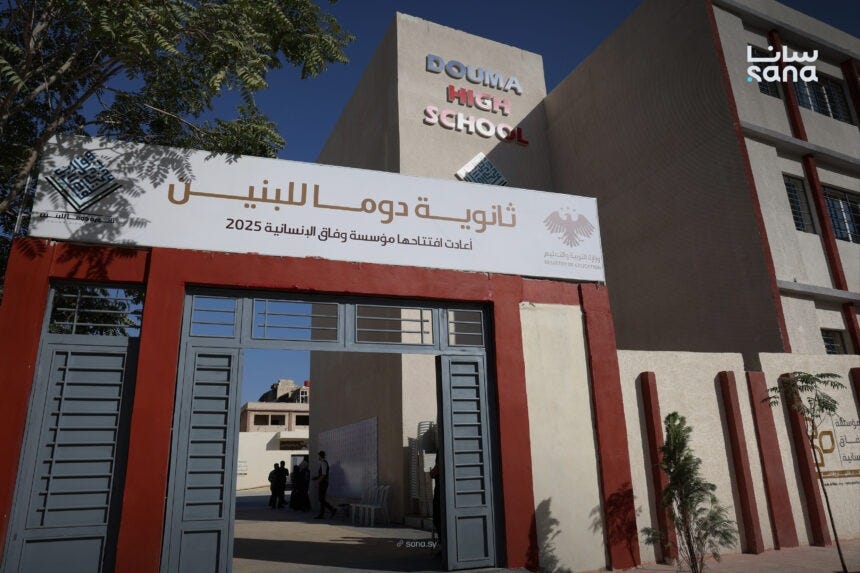
Renaming “Basil al-Assad High School” as “Douma High School for Boys,” for example, symbolically returns the institution to its locality. Under the former regime, naming schools, streets, hospitals and public squares after members of the ruling family was about treating public capital as private property. Removing those names does not necessarily erase history, but ends the compulsory public glorification of a ruling family that treated the country as its own estate.
The case of Nizar Qabbani, one of Syria’s best-known modern poets, is fundamentally different. In September 2025, Aleppo’s General Directorate of Education initially ordered that two schools named after Qabbani be renamed after one of the Prophet Muhammad’s companions. Qabbani’s poetry on love was already an assault on social despotism, and after 1967, he made it explicitly political, turning his gaze on repression and authoritarianism. He spent much of his later life in exile and passed away in London. The removal of his name from two schools launched a public outcry, and following an intervention by the Minister of Culture, the Minister of Education announced that Qabbani’s name would remain. I would especially like to recall “Margins on the Setback Notebook,” where Qabbani is reflecting on the Arab defeat in the six-day war against Israel. Here’s an excerpt:
O my lord…
O Sultan,
I have lost the war twice
Because half our people… have no voice
What is the value of a people without a voice?
Because half our people are trapped like ants and rats within these walls.
If anyone would grant me safety from the Sultan’s soldiers,
I would tell him: You have lost the war twice
because you have abandoned the faith in the cause of humanity
..يا سيدي
يا سيدي السلطان
لقد خسرت الحرب مرتين
لأن نصف شعبنا.. ليس له لسان
ما قيمة الشعب الذي ليس له لسان؟
..لأن نصف شعبنا
..محاصرٌ كالنمل والجرذان
..في داخل الجدران
لو أحدٌ يمنحني الأمان
..من عسكر السلطان
..قلت له: لقد خسرت الحرب مرتين
..لأنك انفصلت عن قضية الإنسان
The decision’s reversal is encouraging. It shows that public pressure can still influence Syria’s emerging symbolic order. But the initial decision is rather revealing. It suggests that some Syrian officials understand overcoming the “effects of the previous era” expansively enough to revise Syria’s cultural and national inheritance without distinguishing between figures associated with the former regime and those belonging to Syria’s broader history.
In my opinion, the case of Jawad Anzor makes this contradiction particularly difficult to ignore. Under Raqqa’s General Directorate of Education proposal, the school bearing his name was to become Al Yaman “اليمان,” a word associated with goodness, blessing and abundance. The new name may be unobjectionable on its own. The question is this: why replace Anzor?
Anzor began his military career at the Ottoman Military Academy in 1915 and graduated as a lieutenant. After the Ottoman Empire collapsed, he continued serving in the Syrian army until he retired in 1945 as a major. He was recalled in 1948 to form and lead a battalion of Syrian Circassian commandos during the Palestine War. He was killed while leading Syrian forces in the battle for Tel al-Aziziyat in the Golan Heights.
His name, therefore, should theoretically tick all the boxes of the Ministry of Education’s criteria. He is a symbol of Raqqa, served in the Syrian army, and was killed commanding Syrian forces in a formative regional war. He also embodies the contribution of one of Syria’s smaller ethnic communities to the country’s modern history. If the new Syrian government considers such a figure and the likes of him as unsuitable for “new Syria’s identity,” then what is at stake is more than removing former regime symbolism; it is about forging an identity without any due diligence.
Sati‘ al-Husri, the philosopher of pan-Arabism, presents a more complicated example. His conception of Arab nationalism can, and should, be critically examined, particularly from the perspective of communities marginalized by homogenizing Arabist projects. But historical controversy is not, by itself, a reason to erase someone from public memory. A pluralistic Syria should be able to remember and critically engage its intellectual traditions rather than fluctuate between glorification and deletion.
The proposed removal of Evacuation Day – the national holiday – from a school is even harder to explain as de-Baathification or de-Assadification. The end of the French Mandate, which Evacuation Day commemorates, belongs to neither the Baath Party nor the Assad family. It is a foundational moment in Syrian national history. Removing its name suggests that the boundaries of the “previous era” may be expanding to include parts of Syria’s pre-Baathist national inheritance.
It’s not as if Islamic history was repressed in Syria. It has long been taught in Syrian classrooms, and many schools have carried the names of religious scholars, rulers and companions of the Prophet for decades. Their presence in public space is not the problem. The problem arises when Islamist symbolism ceases to be one component of Syria’s identity and becomes the principal filter through which all other components are judged.
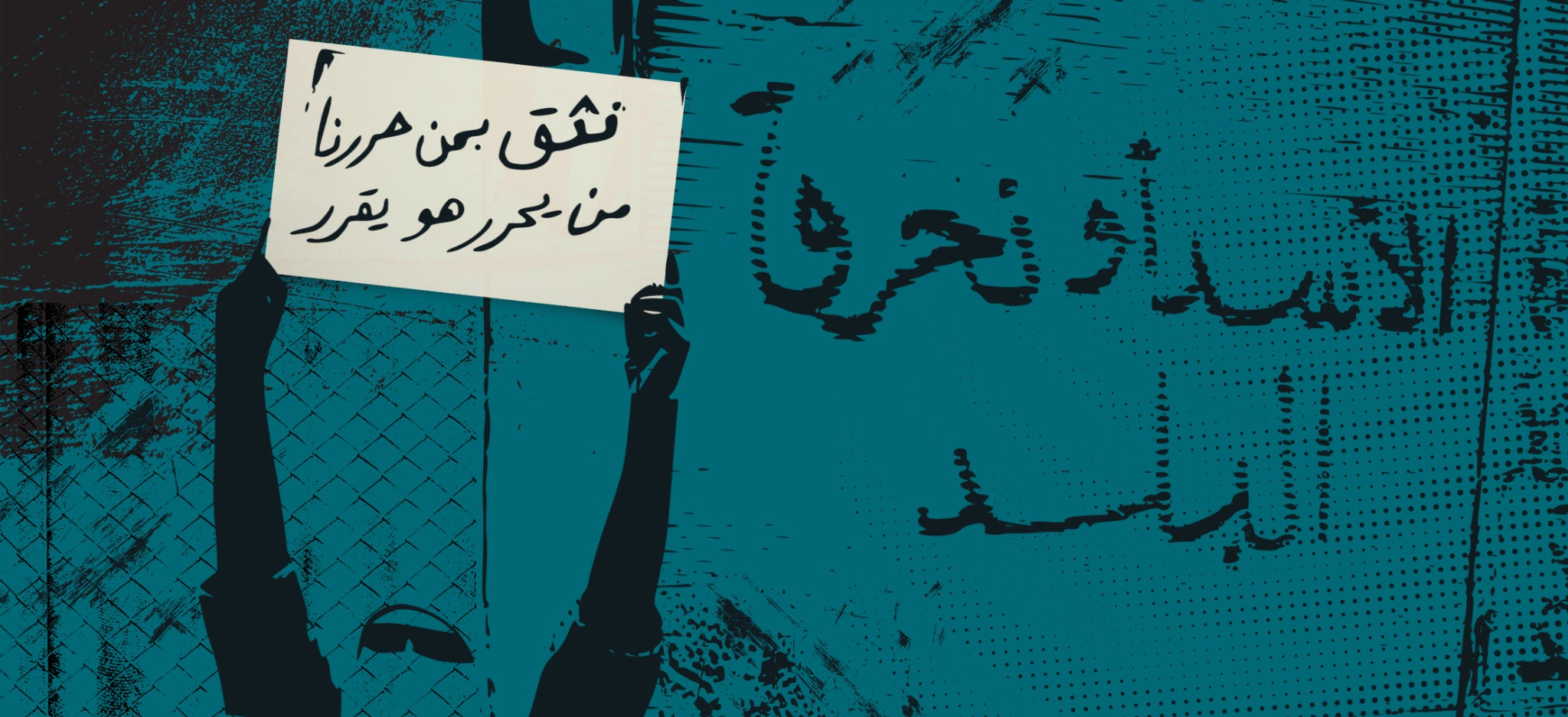
Of course, the naming policy is significant beyond its application to schools. It offers a glimpse into Damascus’s rationale for power. Those who toppled the former Syrian regime believe they have earned the right to define the country’s identity. Colloquially, pro-government Syrians refer to this as “who liberates, decides [من يحرر يقرر].”
This is in conflict with the fairly liberal democratic image that Syria is projecting in the West. Taking those ideas seriously would require safeguarding the various aspects of the country’s historical and national identity. Washing away the contributions of Syrians because they were, or are secular, ethnically different, religiously distinct, or associated with a political tradition that has fallen out of favor would reproduce the exclusionary logic of the past.
The true test of Syria’s new identity is not whether it can replace the former regime’s symbols. It is whether it can resist inheriting the regime’s practice that whoever controls the state also owns the country’s memory. Monopolizing public space through a single narrative and a single repertoire of symbols would not mark a break with the past. It would reproduce the past’s governing logic under different names.
