
Equality as Demotion
For Turkey's professional class, Europe's flat hierarchies feel like a loss

Hi folks,
We’re back to the topic of emigration from Turkey, this time with a guest post by Nick Ashdown! I’ve been bugging Nick to write a post about this for a while, so I’m glad that he finally did.
Nick is a meticulous journalist who has been working on Turkey for well over a decade, and currently lives in Brussels, which means that he’s ideally suited to comment on this topic.
Note that Nick has his own Substack — Meydan — so do follow him for more of his commentary and reporting!
Best,
Selim
A few months ago I inadvertently sparked a lively discussion about class divisions in Turkey after having an unexpected viral moment on social media. I wrote a thread on X recounting an anecdote about how some white-collar Turkish immigrants in Europe end up moving back after realizing they lost the perks they once enjoyed back home (this is a very specific subset of returnees; most people don’t move back, and those who do have many reasons unrelated to the following). These perks include a privileged, entitled social status accompanied by a kind of deference from most of the population, as well as an exceptional level of service provided by a huge, largely impoverished working class bending over backwards to tend to their every need.
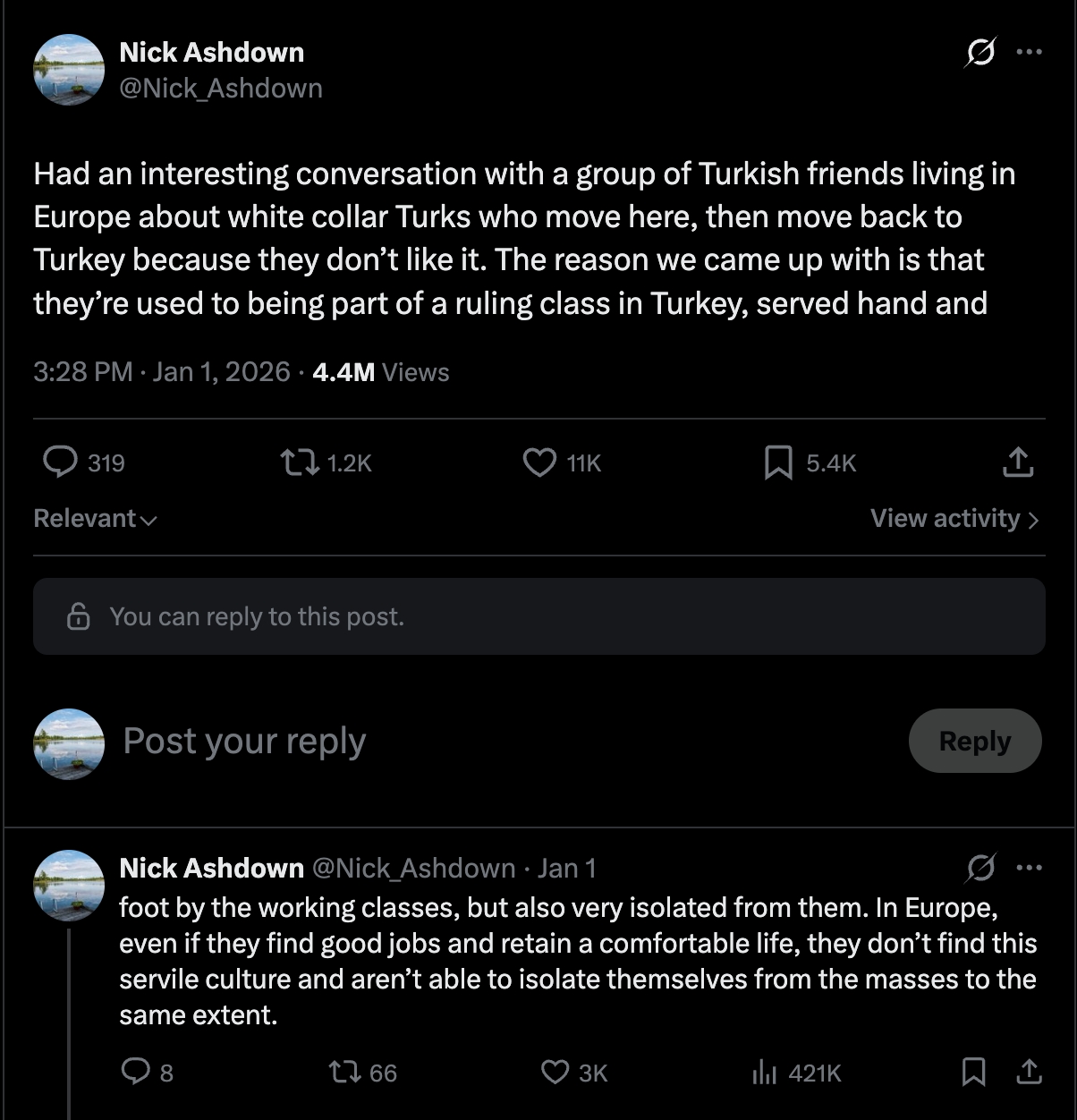
I wrote that this group of Turkish returnees was used to being part of a “ruling class” in Turkey, and the loss of this status in Europe is partially what led them to come back. Ruling class isn’t quite the right term though. Turkey’s real political and business overlords have little reason to leave their sumptuous lives for Europe.
The professional class I was referring to isn’t a ruling elite, but rather a privileged managerial class and cultural elite; part of the top 30 percent, but not the top 10 percent. But this upper layer lives at several removes from the majority of the population in Europe’s most unequal country. The top 30 percent owns 87.8 percent of the national wealth in Turkey, compared to the bottom 50 percent, which holds just 3.4 percent. Meanwhile, half the population between the ages of 25-64 lacks a high school diploma.
Who Is Leaving Turkey?

Emigration from Turkey into Europe and North America has been a very prominent topic in the last decade.
This professional class may not control the upper echelons of Turkey, but, as another person on X wrote, they’re accustomed to feeling elite, and this feeling is what they lose in Europe. This is an especially bitter pill for the class that grows up being told they are ‘modern’ and European, but when they come to Europe they’re faced with the fact that A: many people don’t accept them as such, B: their education, language skills and western lifestyle mark them as quite ordinary rather than elite, and C: they sometimes find it much harder to adapt than expected, compounded by the fact that most Turks migrate to the more northern parts of Europe with cultures and climates most distant from their own.
In Noontime in Yenişehir, a 1973 novel exploring various social cleavages in Ankara, the leftist author Sevgi Soysal narrated a scene describing the awkwardness between two men of different classes [emphasis mine]:
Doğan assumed that when someone of a different class came to their home, people like Ali and his family would grow tense and flustered, unsure of what to do. Like the university janitors or building attendants who came to his family’s home. Whenever Doğan went to the building attendant’s apartment to let him know that the heating wasn’t working properly, the attendant would be baffled as to how to behave and, clearly feeling ill at ease, would make Doğan feel ill at ease too. An unscaleable wall would rise between them.
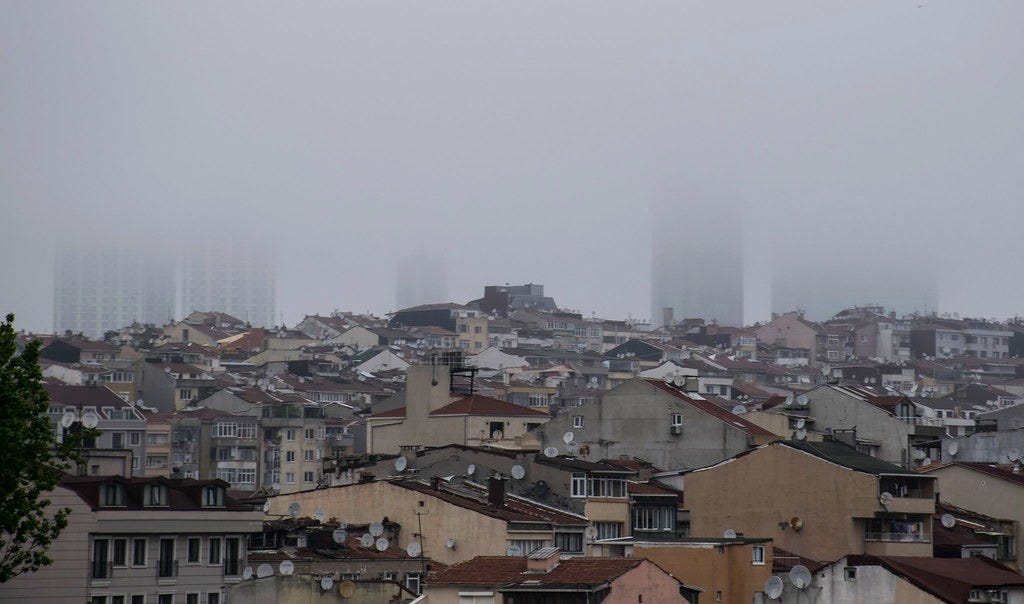
This resonated with me because I’d always been struck by a certain aloofness, leeriness, and even hostility from Turkey’s educated elite towards the majority of the population, regarding their fellow citizens as aliens, and huge swathes of their own country as a dangerous, foreign planet.
You can certainly find these attitudes and class divisions in every country, but like many rifts in Turkey, this one always felt starker to me. There are historical and political reasons for this, but also the basic fact that Turkey is a strikingly unequal country. The class tensions always seemed like a key component of Turkish society to me, and one that’s understudied by foreign scholars and observers more likely to look at ethnic, religious, and political schisms. One of the key characteristics of the Erdoğan era has been the rapidly growing economic inequality and the decay of the middle class.
Barbaros Şansal, a fashion designer and one of the country’s most colourful dissidents, once described to me Turkey’s “invisible caste system,” and condemned the impunity exercised by the elite classes (Barbaros himself is quite wealthy, to be sure). “If you are rich and powerful, you’ll never go to jail, never do your military service, never stop at a red light,” he told me.
My X thread sparked a far-reaching, sometimes heated conversation with hundreds of people (with more on Bluesky). Several of the responses mentioned the invisible caste system that Barbaros mentioned, claiming many people miss it when they move to Europe. Others talked about the difference in signalling social status in Turkey compared to Europe.
“[E]verything in Turkey is a status symbol: your parents’ jobs, whether you drink alcohol, owning a Dyson vacuum cleaner, the school you attended...These people are used to being seen as high-status because their company provides a car or phone,” wrote a white-collar professional based in Portugal. Another wrote that “[Turkey’s elites] are accustomed to establishing a sharp hierarchy between themselves and everyone else, from the person filling their shopping bags at the supermarket to the cleaner who comes to their home, from the courier they can reach at any time, to the waiter at the restaurant.”
Settling in Europe often obliterates these status markers for many reasons. “Even with good jobs, Europe offers far fewer invisible status buffers: flatter hierarchies, less deference, fewer symbolic privileges (such as private offices or company cars), and much less distance from ‘the masses,’” wrote a researcher and teacher living in Warsaw. In Europe, “when [Turkish professionals] see the waiter going to the same gym or the plumber waiting in line at the same café, they are confronted with the reality that they are actually ‘equal’,” said another. This equality “is experienced as a loss of status” wrote a third.
There’s an anecdote in an old documentary about Turkey that illustrates this class divide. The daughter of a wealthy businessman, part of Turkey’s old secular Establishment (and now a well-known analyst), recounts her surprise at the comparatively lower isolation between classes in the United States (an ironic observation, as the US is one of the most unequal countries in the OECD): “When I went to Washington...I was extremely confused to see the woman serving coffee [in my cafe] also [working out] at my gym, because in Turkey that would never happen. You would live in totally different parts of town; you would do different things.”
For more of Nick’s excellent writing, follow him on his own substack:

Others on X mentioned differences in service culture. I’ve often heard Turks (and Americans) in Europe complain about a low level of service here, and frankly I’ve complained about it too (I’m Canadian), but it took me a while to realize this is largely the result of having the most robust worker’s rights in the world (albeit suffering a long decline). That’s why stores close early, workers are constantly striking, and service employees don’t grovel before customers or take special pains to earn their tips (which they don’t need, since they’re paid fairly).
Service is typically excellent in Turkey, though can sometimes come across as uncomfortably obsequious or aggressive to an outsider. When you walk into a store, employees will often offer you tea and follow you around. Workplaces often have a çaycı – a person who brings you tea – working inhouse or nearby. Cafes often offer small items as ikram (on the house). Most larger apartments have a live-in kapıcı (doorman) who takes care of the building, and often serves as general errand runner and more. The cost of living and inflation in Turkey have been skyrocketing much more than Europe for years now, but traditionally even the middle classes have been able to easily afford things like a regular house cleaner, and workplaces often provide services like catering.
However, this exceptional Turkish service culture and the corresponding expectations for a high level of service by those who can afford it are enabled by an abundance of cheap labour often working in awful conditions with few rights. During the conversation I referenced in my online thread, one of my Turkish friends put it bluntly: “They basically want slaves.”
These high expectations are compounded by what can often be a very different culture around service. When they come to Europe, some white-collar Turks are taken aback that people are often expected to clear their own trays, throw away their glass bottles in special bins, come down to apartment building entrances to meet couriers (in Turkey they come up to your door), and use self-service gas stations (unheard of in Turkey). As a Turkish writer living in the Netherlands explained in a thread from 2023, “This latest generation [of Turkish immigrants] is looking for the same deep-cleaning housecleaners, long-term care-givers, hairdressers where you don’t need an appointment, high quality grilled meat restaurants [ocakbaşı] and private teachers praising their children, [things] that they have in Turkey...Some people still can’t understand why [in Europe] the lunch break is only 30 minutes long, or why CEOs eat sandwiches for lunch brought from home.”
My experiences visiting family in Turkey and Canada illustrate similar cultural differences around service, hospitality and work. In Canada, everyone is expected to pitch in, including guests: we alternate between who cooks, everyone cleans up together after meals, and we always tidy after ourselves, especially before leaving. In Turkey, my mother-in-law does absolutely all the cooking and cleaning herself, my father-in-law chauffeurs us around, and we’re generally treated like royalty. When my in-laws visit us in Brussels, the idea of them staying in a hotel (the way my Canadian family does) is unthinkable.
Growing up middle-class in Canada (a country with its own hierarchies and underclasses), scrubbing the toilets and doing many other weekly chores was a standard part of my adolescence, as well as working part-time and summers in sometimes less than distinguished jobs (fast food, a discount grocery store, and that one summer promoting dog biscuits while wearing an actual dog suit). For the comfortably middle-class in Turkey, it’s often the mothers/grandmothers or paid workers who do the household chores, and children don’t generally work unless their families need the money (they’re usually too busy doing never-ending exam prep anyways).
Turks in Europe often complain about slow healthcare, or doctors giving (what they consider) insufficient tests and medications, but they’re usually comparing public healthcare here with high-end private healthcare in Turkey that operates like a commercial business, treating patients like consumers. I once had to stay in one such hospital in Istanbul, and it was essentially a luxury hotel staffed with doctors and nurses - I chose my pillow from a menu and had to fight off nurses trying to give me expensive intravenous painkillers despite being in only minor pain. But most Turks can’t afford such hospitals. Similarly, there are high-end luxury supermarkets, malls and giant, largely self-contained gated communities in Turkey, in what amounts to a whole separate world for the wealthy.
There’s another feature of Turkish work culture that’s notable here, one that’s much closer to America than Europe. In Turkey, the average person lives quite a difficult life, but dreams of pulling themselves out of economic precarity by working hard, buoyed by either a strong entrepreneurial spirit or faith in a state-provided meritocratic system of standardized tests and top-tier public schools and universities. People want to work hard, earn good money, and enjoy the accompanying elite status and comforts without having them disparaged or taxed away like in Europe.
Brussels-based writer Fırat M. Hacıahmetoğlu summed it up well:
Their actual goal in moving to another country was to take their existing lifestyle—based on consumption, social status, and ostentation—to the next level. Due to a misunderstanding, they thought they could achieve this in Europe, but when they found the culture there to be the exact opposite, they were taken aback. The place they actually wanted to go was America.
Turks largely believe in the possibility of social mobility, and feel that egalitarianism in Europe is forced upon them no matter how hard they work. One of the comments online illustrates this view: “[Europe] flattens the masses to a single level under the banner of social democracy, leaving everyone stuck there…most Turkish people operate on a similar level back home: work hard, climb ladders, and have more things (services/goods) with your money.”
However, this perception of high mobility in Turkey, low mobility in Europe is backwards. Though elite public universities and lycées used to provide a powerful engine of upward mobility in Turkey, the country still scores very low on global mobility scores (much lower than America, or even Russia or China), while Europe scores highest. Turkey’s public educational system has crumbled under the Erdoğan government, but even in the past, social mobility was hampered by private dershanes (tutoring schools) that most people couldn’t afford, and huge ethnic, regional and gender disparities.
Another insightful response to my thread, from scholar Ali Tirali (himself a bit of an unapologetic elitist), describes the specific form of classism in Turkey that comes not from family background but perceived merit:
Although there is a generally classist ethos in Turkey, this classism is aristocratic in character, based on a correctly or incorrectly adopted idea of meritocracy rather than class privilege inherited from older generations. Most white-collar workers in Turkey come from families where the previous generation were minor civil servants, tradespeople, labourers, etc. Although social mobility is now very difficult in Turkey, this illusion is kept alive by the national examination system and the ethos of education.
Feeling (often rightly so) that they’ve earned (rather than inherited) their socioeconomic status, on top of the gulf between classes and social groups, can naturally instill someone with a sense of superiority and entitlement, and a need to erect Soysal’s “unscaleable wall.” I think resentment towards this haughty attitude is what triggered so many comments to my thread.
 | A guest post by
|
Great piece! I can't believe I hadn't heard of Nick Ashworths Substack before and immediately subscribed. I had a similar impression with Turkish friends in Europe (though the post brings it out in much more detail). I noticed that they often applied to fairly prestigious jobs or grumbled about not obtaining such a 'high status' job, jobs other students I knew would not apply to thinking they wouldn't qualify. The disdain for the masses is something I have heard from secular and islamists friends and always confused me. It also influences how people imagine a more developed Turkey (are there no servants or does everyone have more servants ?). Excellent piece I'll go and read more of Nick's writing :D
The tutoring/examination system is the exact same system that exists in any other developing countries whether its Iran, India, South Korea or China. There is nothing particularly “unequal” about it in Turkey compared to those countries and the results in Turkey do not correlate with wealth at all.
Thats why it is usually lower middle class folks that thrive in these exams, not the upper class that don’t need to be upwardly mobile. Its important to remember, the regional and ethnic inequalities you refer to are almost entirely cultural: there are large segments of conservative muslim and Kurdish society that don’t want to have their children be educated and independent.
The success of Tunceli in standard exams is an example; they don’t have the same cultural obstacles, therefore, despite economic underdevelopment relatively speaking, students from there are disproportionately successful.
Compare that to Canada, where the entire system pushes overly qualified immigrants into low wage, unskilled work while incompetent and exceptionally lazy Canadian natives gatekeep every single industry. They wouldn’t be able to do that if Canada had a stratified examination and university system like in other countries, where competency is more easily ranked. Europe suffers from the same problems, leading to near zero growth and increasing debt burden for more than a decade.